
HWS News
30 October 2026 From Overwhelmed to Whelmed
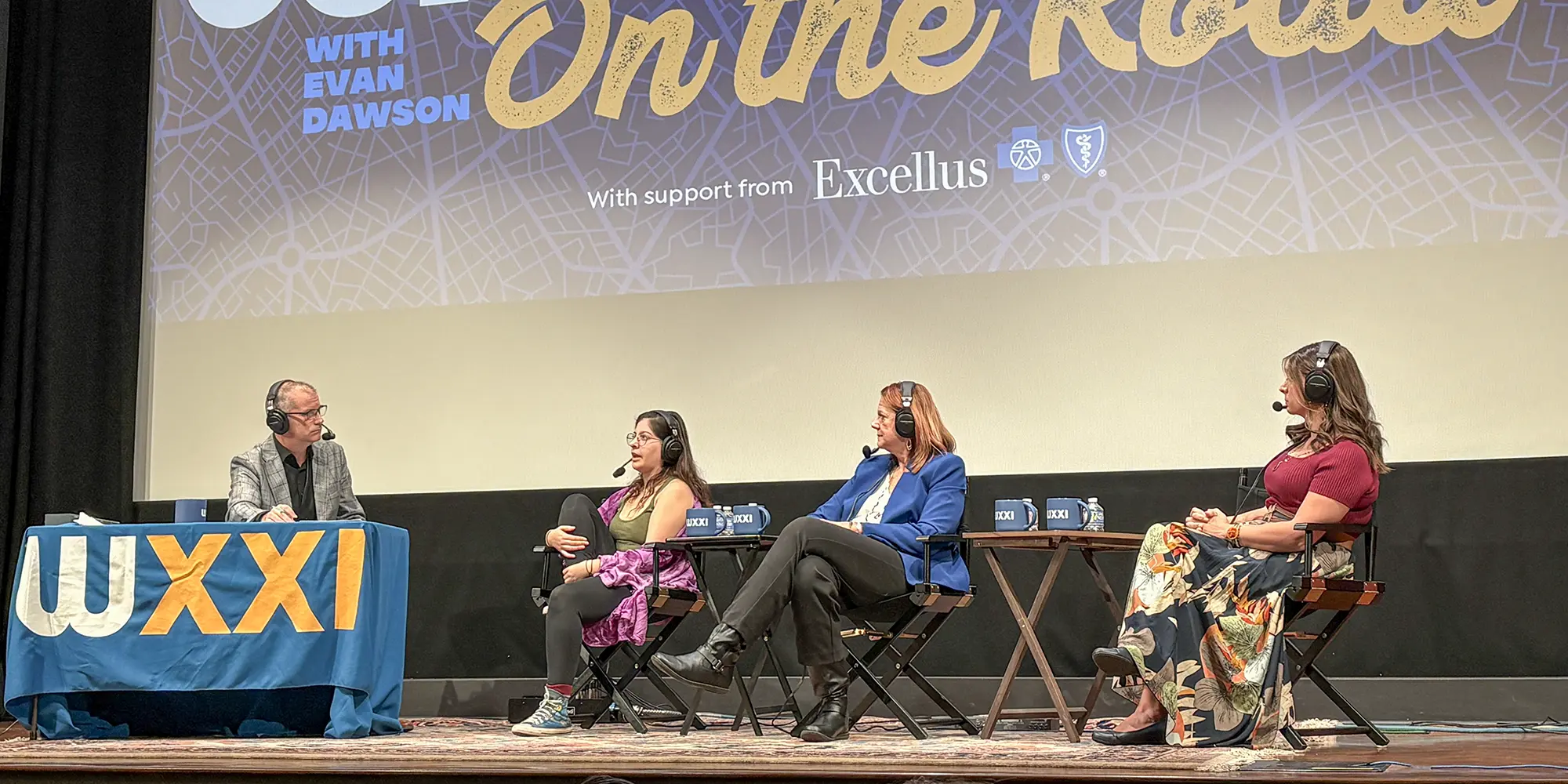
At a live broadcast last week of WXXI’s show “Connections,” HWS Vice President Dr. Becca Morris joined a panel discussion on how colleges are helping students navigate anxiety, academic pressure and an uncertain world.
For psychology major Giulianna Volpe, depression began during her second semester at Finger Lakes Community College. Worries about the future started to mushroom: “I'm going to have to get a car soon. How am I going to be able to afford that? I’m going to have to transfer to another campus. Where is that going to be? How much is it going to cost? Am I going to have to live there? How much would that cost?”
Then the Canandaigua native found herself struggling with thoughts that frightened her even more. “That same night, I started to get pretty negative thoughts about, well, ‘What if I wasn’t here anymore? I wouldn’t have to deal with it.’”
Volpe shared her experience at the Little Theater during a live discussion last week devoted to student mental health on WXXI's “Connections with Evan Dawson,” where her story brought a personal dimension to a national concern.
According to figures Dawson cited from the Healthy Minds Study, an annual, web-based survey that has gathered data from over 935,000 respondents across more than 675 colleges since 2007, 37 percent of college students screened positive for depression, compared with approximately 10 to 11 percent 25 years ago. Another 33 percent screened positive for moderate to severe anxiety, while 11 percent reported seriously considering suicide within the past year.
The Oct. 22 broadcast brought together Volpe, Hobart and William Smith’s Vice President for Campus Life and Dean of Students Dr. Becca Morris and SUNY Brockport’s Director of Counseling Darlene Schmitt to discuss the challenges facing college students today.
For Morris, who has worked at HWS for 17 years, supporting student mental health is not reserved for counseling services alone.
“I think the biggest thing that we've seen at HWS is the idea that mental health is a community responsibility,” Morris said, emphasizing the roles of faculty, staff and students in helping each other. Morris pointed to HWS' participation in the JED Campus initiative.
With support from Vice Chair of the Board of Trustees Cassandra Naylor Brooks ’89 and former Trustee Dr. Paula Miltenberger P’23, the four-year collaboration with the nonprofit JED Foundation has served to strengthen mental health, substance misuse and suicide prevention efforts to create a holistic mental health support system not just for students but the entire HWS community.
Following an assessment of campus resources and student awareness, HWS expanded access to counseling, including evening and weekend appointments and remote and crisis services available around the clock. Morris says approximately 20 percent of HWS students seek counseling during an academic year.
HWS’ Personal Empowerment course, which she said approximately 20 percent of students take during their time at HWS, also teaches emotional regulation, stress management and the language students need to recognize and communicate their feelings.
Morris described the importance of helping students move “from being overwhelmed to just being whelmed” as a step toward positive mental health.
Volpe recounted pulling out her phone to call her college’s counseling services and connecting with a counselor she began seeing regularly. It was a fantastic experience, she said. Through her sessions, she said she began to see a future beyond her immediate worries.
Young adults encountering financial pressures for the first time, Morris said, often have little experience to draw upon when considering whether those conditions will improve. Learning to identify those feelings, seek support and develop coping strategies can help students manage their uncertainty.
The one-hour discussion also examined social media, academic competition and the pressure to achieve high grades. Morris noted that HWS allows students, after completing a course, to elect a credit/no-credit designation under certain circumstances, providing some flexibility when personal challenges interfere with academic performance. About 3-5% of students utilize this option annually.
Audience questions brought additional perspectives, including concerns about the loss of hope and purpose among some young adults.
The Rev. Sam Kinsman, Protestant chaplain at both the University of Rochester and Rochester Institute of Technology, described seeing a growing sense of hopelessness among Generation Z students.
“Nothingness, this ennui, this ‘What's the point?’ is being felt as a burden on the shoulders of Gen Z, and it's either manifesting panic attacks or it's manifesting the desire to sleep for a long time. It is a weight on their bodies, on their souls.”
Panelists discussed helping students identify their interests, discover their strengths and recognize the choices available to them. Morris described conversations with her own teenager about possible academic and career paths, emphasizing the importance of exploring interests rather than feeling compelled to settle on a particular future too early.
Morris also addressed the role of social media in heightening anxiety, describing how students can feel excluded even through ordinary interactions they encounter online.
“We … see our students not just as students; we provide them a human-centered education,” Morris said, explaining that students are whole people with pressures of family, work, athletics and other responsibilities.
For the President’s Forum on Nov. 19, President Mark D. Gearan invited Executive Director of the Coalition for Student Wellbeing Carson Domey for a conversation devoted to student mental health. Domey works with student leaders across U.S. college campuses to ensure student voices and experiences are heard by higher education leaders and administrators. He will discuss the organization’s mission with Gearan, who serves on the Coalition’s Advisory Board.
Domey, who graduated from high school in 2022, began advocating for mental health awareness as a teenager after losing a friend to suicide in 2018.
For Volpe, who immediately sought counseling services during her crisis, she is working to manage her worries with patience and perspective and an understanding that solutions do surface. It may have taken a year of searching for an affordable car but ultimately, she said, she found the perfect one for her needs and budget.
When asked by City of Rochester commissioner… “What can high schools do to support teenagers’ mental health?”
“A course like Personal Empowerment,” Volpe replied. Starting in summer 2027, HWS’ Personal Empowerment will roll out a high school version of the course via a two-week summer residential experience called Rise!.
Volpe said she remains concerned about college expenses but is looking ahead to transferring, encouraged by financial aid opportunities and the support she has received.
“Things in the future are going to happen,” she said. “But it's figure-outable.”
Top: From left to right, “Connections” Host Evan Dawson, Finger Lakes Community College psychology major Giulianna Volpe, Vice President for Campus Life and Dean of Students Dr. Becca Morris and SUNY Brockport’s Director of Counseling Darlene Schmitt.

