HWS News
25 September 2026 The Science Beneath the Science Building
By the time the Fish Center for the Sciences opens, ancient sediment hidden beneath it may already be helping students investigate one of the Finger Lakes' oldest mysteries.
Eight feet beneath what was the basement of Eaton Hall, construction crews this summer opened a rare window into the region’s ancient past.
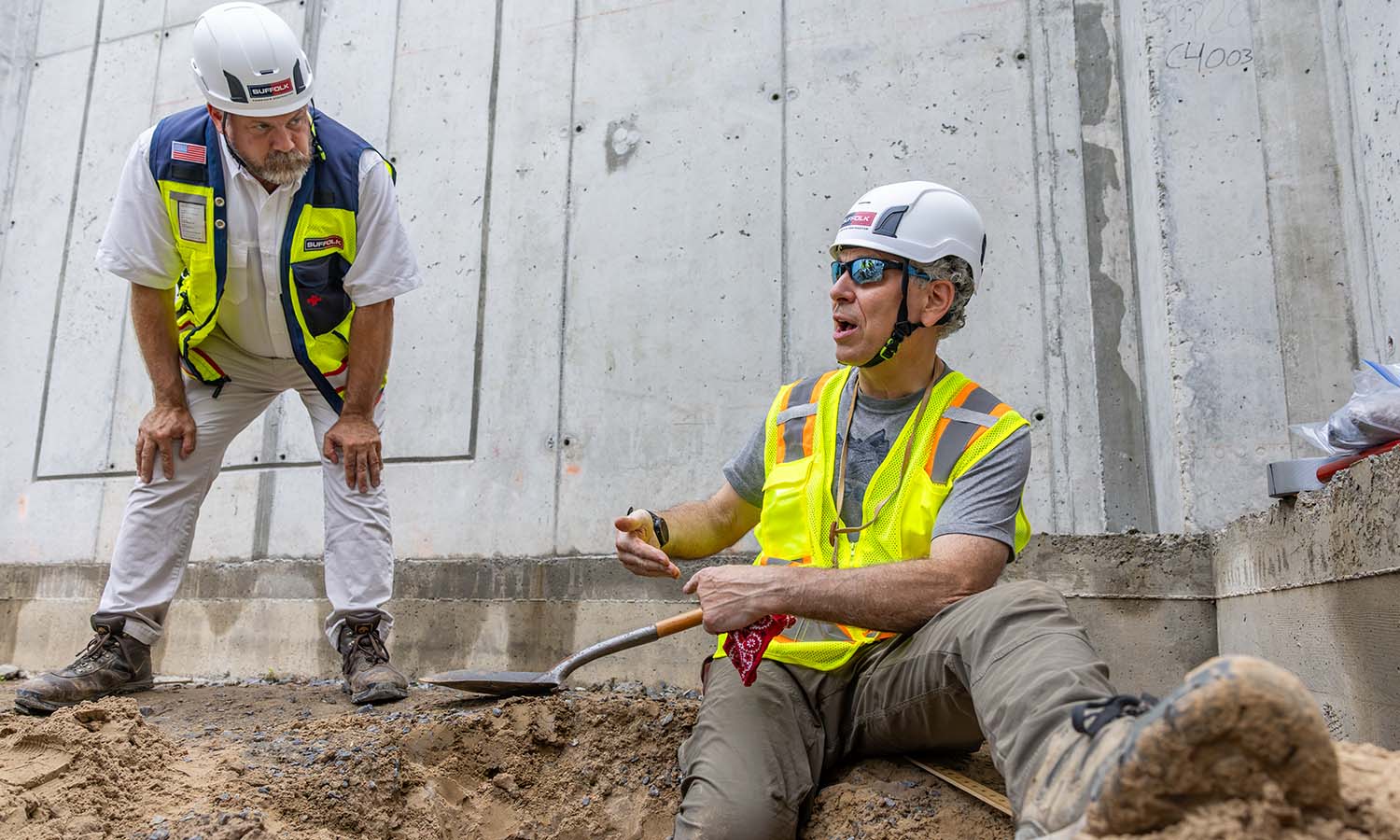
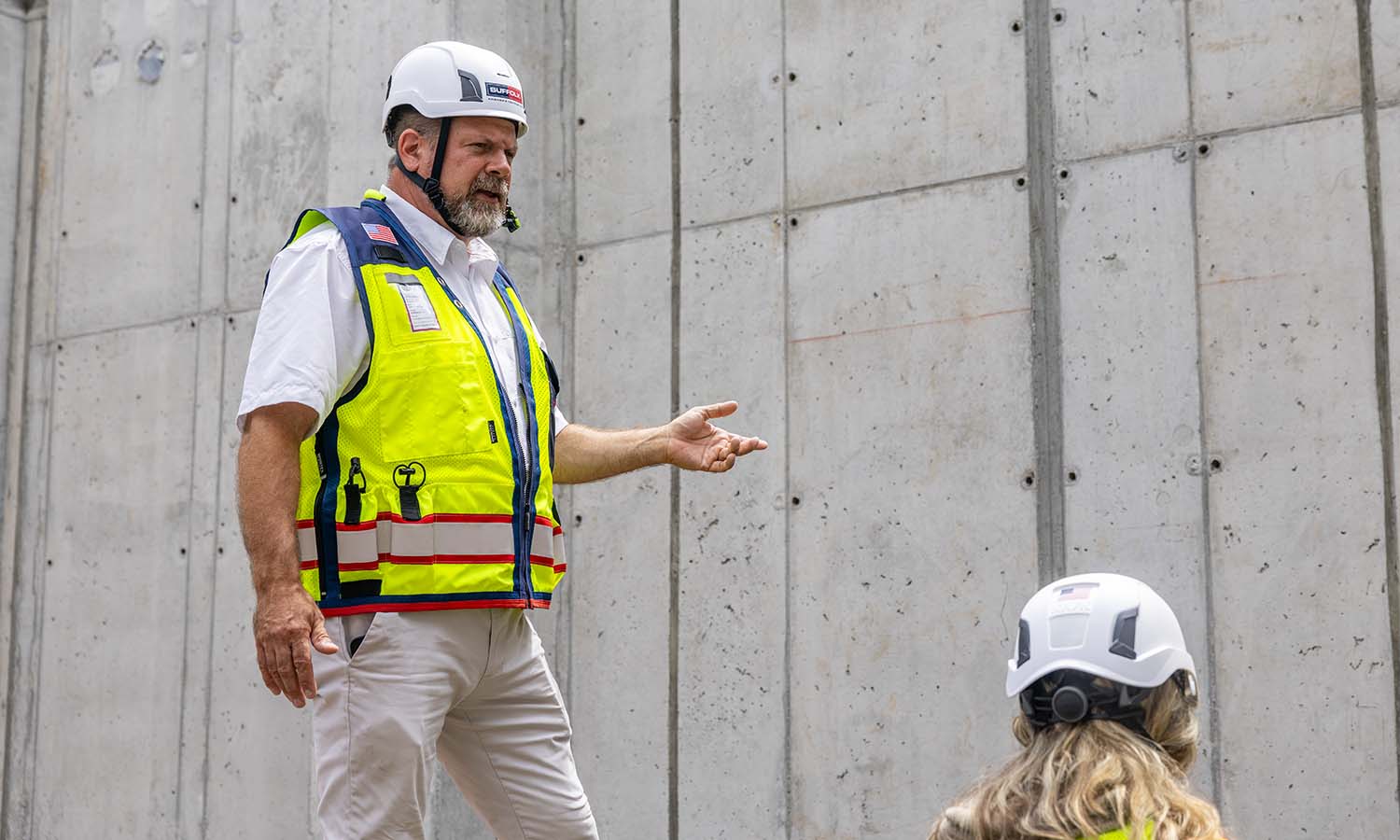
Steve Bell, a senior superintendent at Suffolk Construction, was the first to spot the anomaly: a patch of gray clay that looked like nothing else around it, he says, in a space no bigger than a Volkswagen Beetle.
Bell has spent his career as a construction superintendent traveling the country, often working on health care projects. At HWS, the geoscientists who could help make sense of what he was seeing were only a short walk away. “I love this geology stuff,” he says. “I geek out on YouTube; it’s my idea of a good time. So, when I saw all this stuff, and I heard that geology professors were nearby, I said, ‘Bring them!’”
Associate Professors of Geoscience David Finkelstein and Tara Curtin, however, weren’t immediately convinced.
“We thought, ‘How is (the clay) related to the till? Is it below or on top of the till? We really didn’t give it much thought beyond that,” Finkelstein says. “But then again, seeing is believing.”
9/25/2026
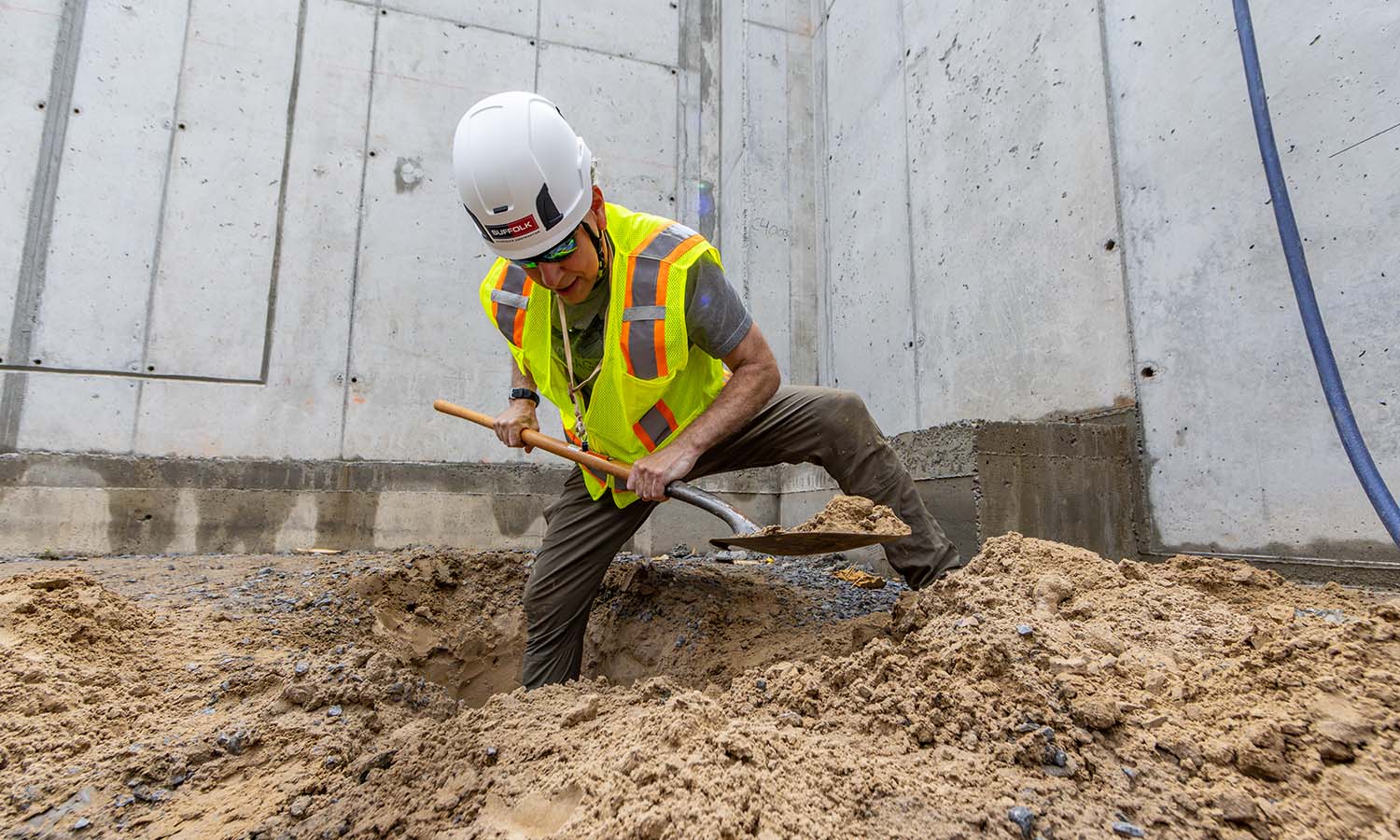
Their attention was piqued once on site by the sequence: sand at the bottom, glacial till above it and laminated lake sediment on top. Each layer, they knew, could preserve evidence of a different environment — and, together, a chronology of how the ice moved across the region.
When a glacier stops moving and begins to melt, the dirt, gravel and boulders inside or on top of the ice are slowly let down onto the ground surface. Because the ice is stationary during the process, the sediment is deposited gently without being smeared or deformed by the glacier’s movement and without being washed away by the melting glacier.
Over the past 2.6 million years, glaciers may have advanced and retreated across the region many times, Curtin says, erasing much of the evidence left by earlier ice sheets as they moved. The layered deposits beneath the Fish Center preserve a piece of that incomplete record — one that researchers can now begin to date and interpret.
“I think the first word out of our mouths when we saw the sand was, ‘Whoa!’” Finkelstein recalls. “I remember Steve said, ‘I told you!’”
Before construction crews began laying the Fish Center’s foundation, Curtin and Finkelstein had to hurry. They spent the next two weeks collecting dozens of samples. Some will be sent to an outside lab to undergo optically stimulated luminescence dating, a technique that can determine when grains were last exposed to sunlight. Results could take between 12 and 18 months.
Dating the bottom layer could prove especially important.
“It really all comes down to the age,” Curtin says.
Other samples will move into classrooms and labs for students in Curtin’s “Geomorphology” and “Sediments and Sedimentary Rocks” courses, where students will ask the questions confronting Curtin and Finkelstein: What is the sand? How old is it? How was it deposited? What does it tell us?
Their work will enter an ongoing scientific debate over the region's deglaciation. One hypothesis holds that the ice retreated northward; another suggests it retreated and then readvanced across parts of the Finger Lakes, Curtin explains.
Evidence capable of settling the question is difficult to find, she says. Geologists can trace moraines — ridges of rock and sediment left at the edge of glaciers — but those features can be difficult to trace across the Finger Lakes, Curtin notes, while deposits suitable for dating are harder still.
The sand beneath the Fish Center, however, gives researchers something they can reliably date.
“What's nice about this pit is that we'll be able to test this,” Curtin says. “We’ve got three layers that are easily explained. We can get an idea about when they were deposited and figure out if the ice did advance again or not."
That’s the goal of one class project, she says. Students will be asked to figure out the timing of different events to better understand how glaciers wax and wane. “It'll give them some unique insights as to how ice sheets grow and then diminish in size; it provides insights as to what's happening in Greenland and Antarctica to give them an idea about what's possible and then why.”
Curtin will familiarize students with known samples of wind- and water-deposited sediment, which they can compare with the sand beneath the Fish Center. From there, they'll investigate how and when the layers of sand, till and clay were deposited.
“The sand on the bottom might be really old. It might be more like 40,000 or 80,000 years old instead of 15,000,” she says.
Curtin says she loves giving students projects where no one knows the answer. “They’re essentially being handed a mystery.”
By the time the Fish Center opens, some of the material excavated to build it will return — in samples students can use to investigate the mystery preserved beneath their feet.
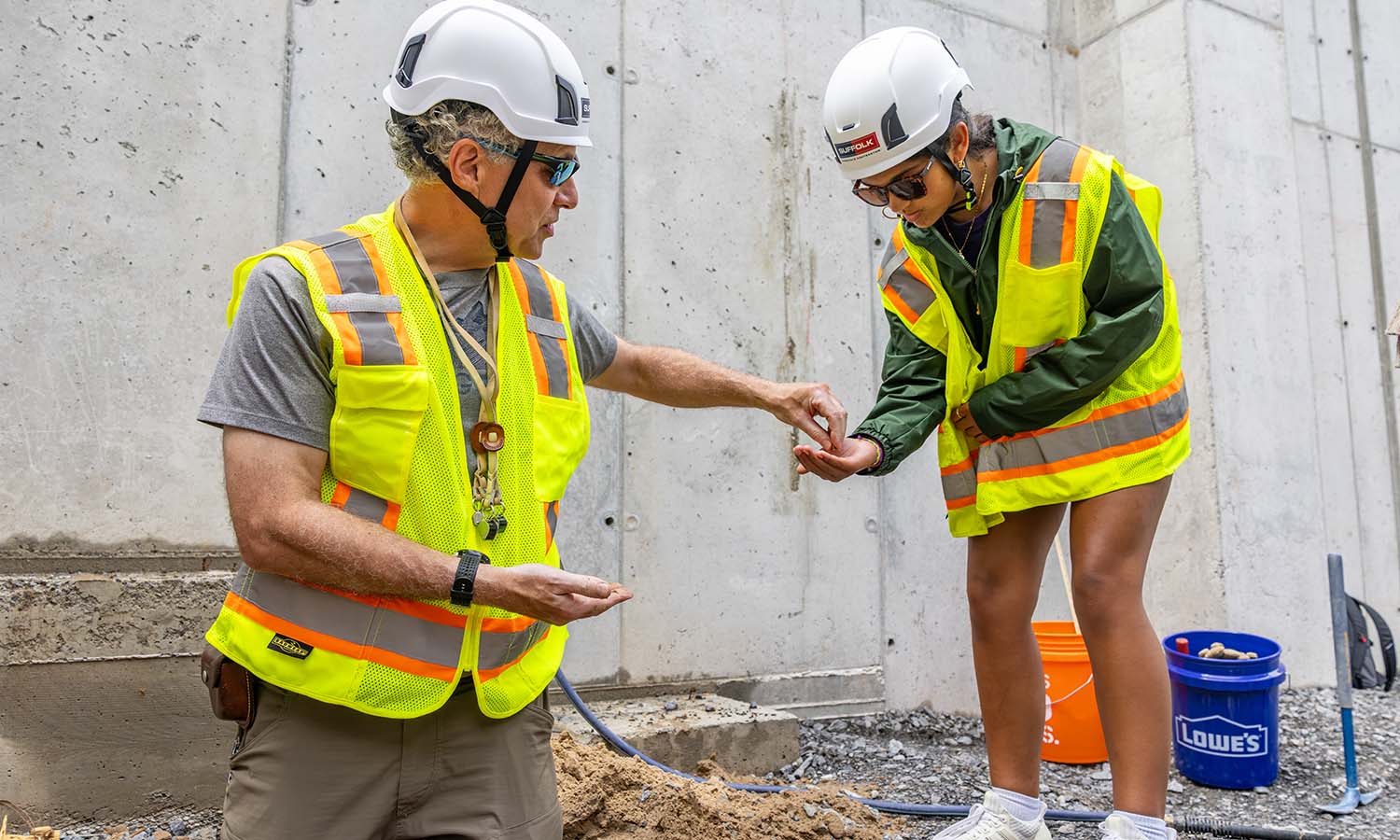
Top: Suffolk Construction Senior Superintendent Steve Bell looks at sediment samples with Associate Professor of Geoscience David Finkelstein.