HWS News
29 April 2026 Art in the Wake of Loss
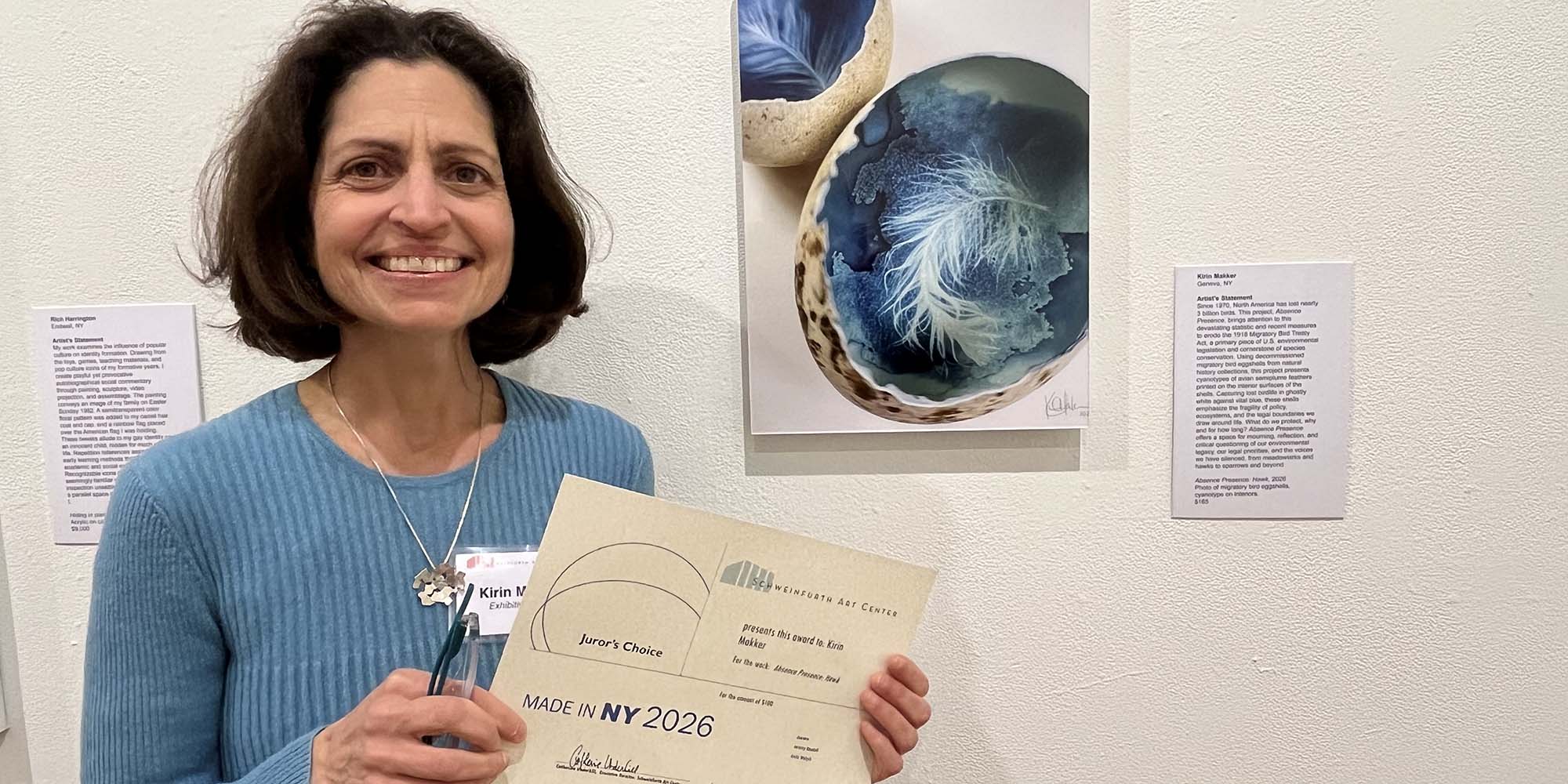
Two of Professor of American Studies Kirin Makker’s pieces in her Absence Presence series were selected for the Made in NY juried exhibition at the Schweinfurth Art Center in Auburn, N.Y., that opened in March and runs through May 16. Makker also received a Juror's Prize for her work.
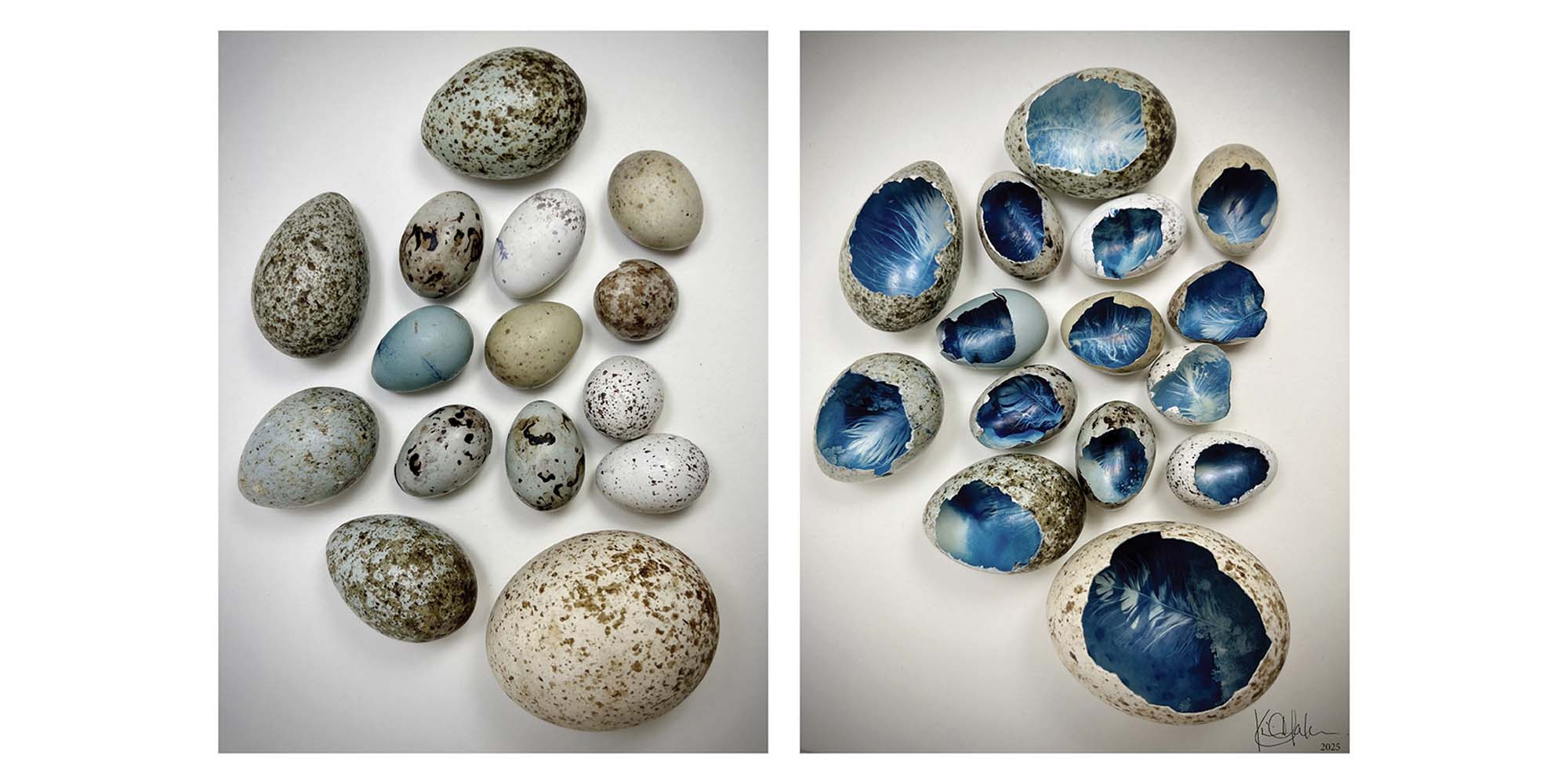
Professor Kirin Makker's work that is part of Made in NY 2026
The 30th annual Made in NY exhibition features work by artists who live in New York and is an opportunity for artists to showcase their work in a competitive, juried exhibition. The exhibit is open to all media, such as photography, sculpture, ceramics, painting, drawing, fiber, installation and video. In 2026, 399 artists applied for the exhibition, of which 70 were accepted. The show includes 74 artworks, including paintings, photographs, jewelry, quilts, sculptures, felted works, and more.
Makker’s Absence Presence presents cyanotype prints of feathers inside migratory bird eggshells. Since 1970, North America has lost nearly 3 billion birds. Her project brings awareness to this devastating statistic and recent measures to erode the 1918 Migratory Bird Treaty Act, a primary piece of U.S. environmental legislation and cornerstone of species conservation. The title, Absence Presence is about the power of a void — to be loud, to communicate strongly, to make meaning. Makker used decommissioned migratory bird eggshells from natural history collections, partnering with the Museum at the Cornell Lab of Ornithology and HWS’ Biology Department.
“Capturing lost birdlife, the work embodies and reflects fragility — of species, policy, ecosystems, and the legal boundaries we draw around life. What do we protect, why and for how long? Absence Presence offers a space for mourning and critical questioning: of our environmental legacy, our legal priorities, and the voices we have silenced, from meadowlarks and hawks to sparrows and beyond,” expresses Makker in her artist statement.
At HWS, Makker teaches courses centered around critical space theory and design. She combines traditional scholarship with creative practice in hand drawing, sewing and installation art. Outside of teaching, she explores women’s and Black history in urban planning and feminist architectural practice. She is also the artist behind the “Womb Chair Speaks” project, which has been on display at HWS, Harvard University, the Center for Interdisciplinary Research on Aging and Care at the University of Graz, Austria, and the Winterthur Museum.