HWS News
16 April 2026 • Arts Conserving Minerva
Wells College’s cherished Minerva statue is made whole again.
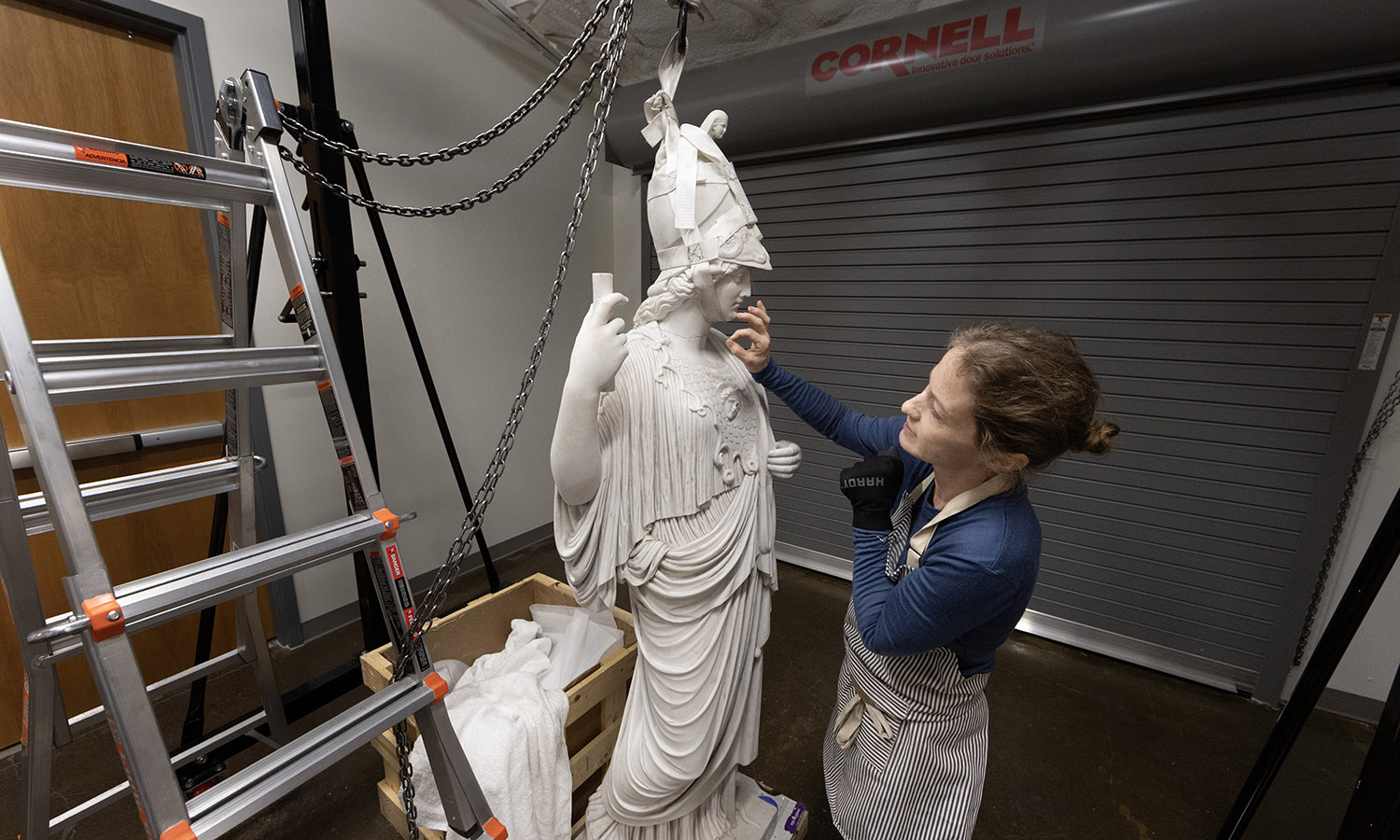
When New York City-based conservator Lauren Paige Isaacs first saw photographs of the stone statue long associated with Wells College, she knew little about the sculpture beyond its condition.
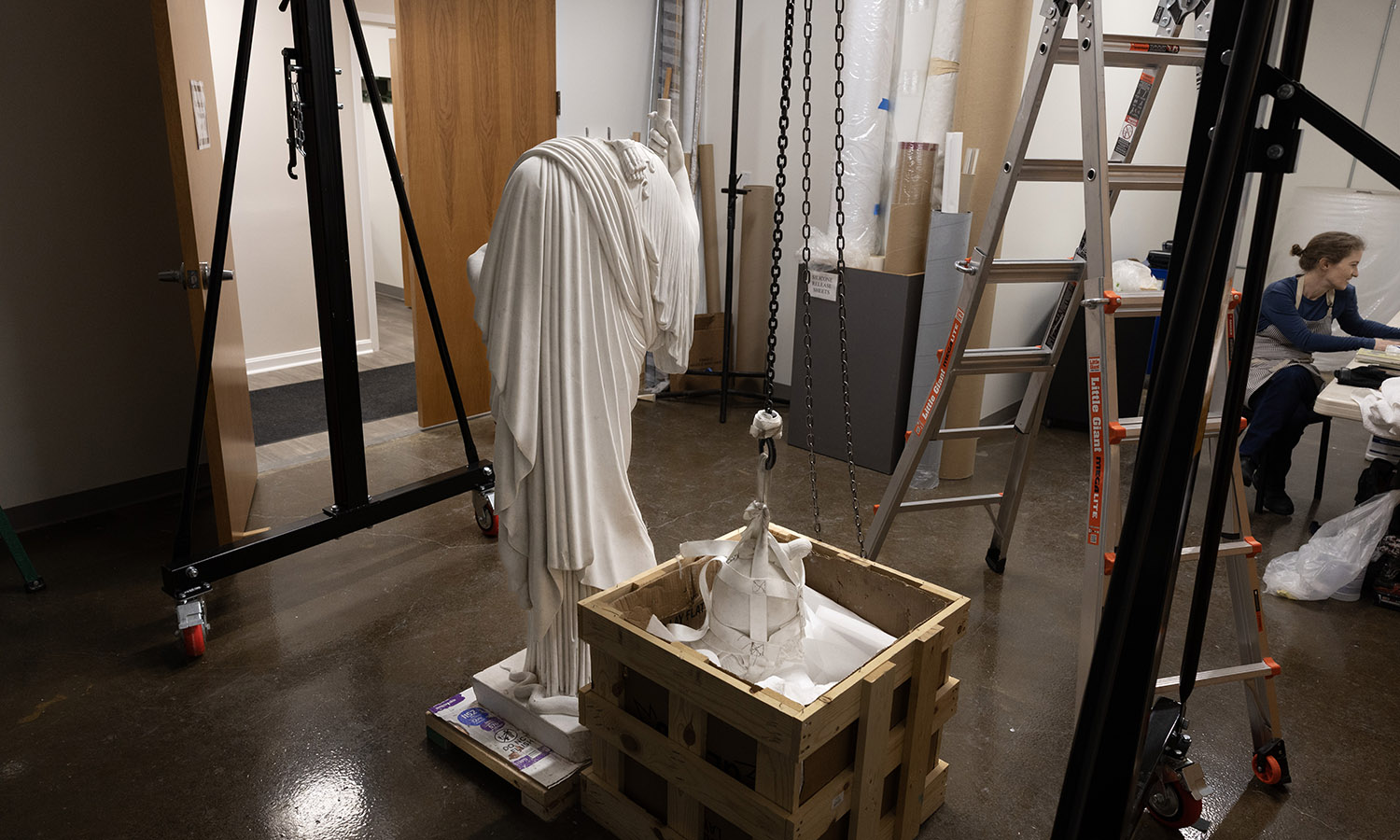
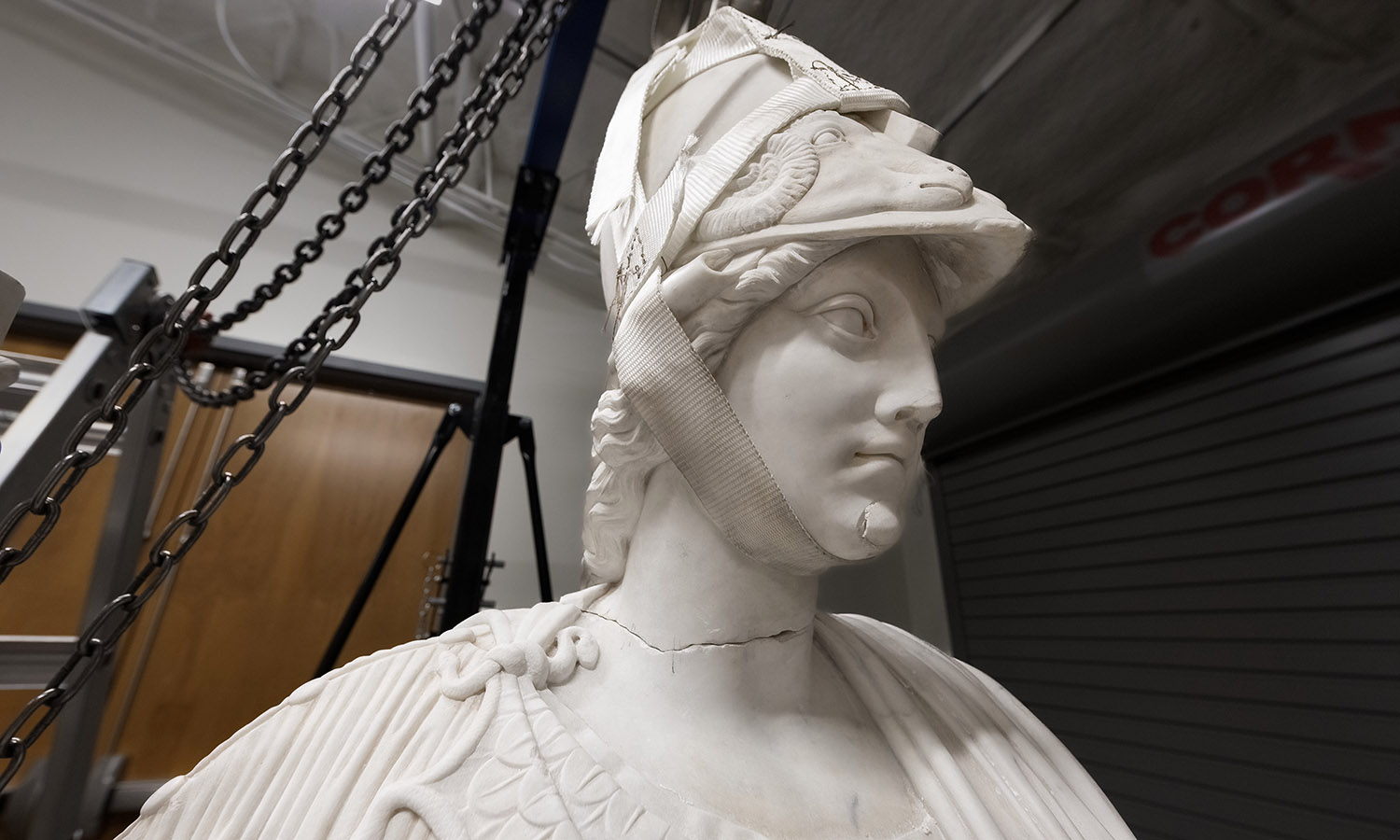
The marble symbol of wisdom and inspiration for generations of Wells students was accidentally beheaded last year during an attempt to protect her from the elements on the Aurora campus by moving her inside. The accident made national headlines and deeply affected many alumni who regard the statue as a touchstone of their alma mater, which closed in 2024.
Through a legacy agreement in 2025, Wells transferred its historical records, artefacts, some of its artwork and endowment to HWS. The agreement includes the Wells Book Arts Center and the Minerva statue.
Conservator Lauren Paige Isaacs narrates the rigorous process of reconstituting Minerva, a beloved 156-year-old marble monument to strength, grace and wisdom.
To make Minerva whole again, HWS subsequently contracted Paige Isaacs — one of few national experts trained in painting, textile, paper and object conservation. With a master’s degree and Certificate of Advanced Study in art conservation from the State University of New York at Buffalo, she provides professional conservation services to museums, federal agencies, art galleries and private clients.
When Isaacs began studying Minerva, she realized the mishap last year created an unexpected opportunity.
Several pieces that had broken off the statue over the many years since it was gifted to the college by Charles Wells in 1868 had been meticulously saved.
Those fragments — tucked inside envelopes and stored for decades — allowed Isaacs to work on repairs that had long eluded Minerva’s earlier caretakers.
Discovering Minerva’s Material and History
Before beginning any work, Isaacs does a deep dive into the subject’s material, environment and history.
Initially, she suspected the statue might be made of marble. Cleaning later confirmed the signature carved on its back: Carrara marble, a prized Italian stone historically used by sculptors across Europe.
The statue is a copy of a classical figure in the Vatican — a common practice in the 19th century, when sculptors recreated famous works to bring European art traditions to the United States.
Stone, Isaacs explains, preserves history in a uniquely durable way. “From the beginning of time, so much of our culture — religion, society, history — has been recorded in stone,” she says.
Photo Gallery
A Repair Decades in the Making
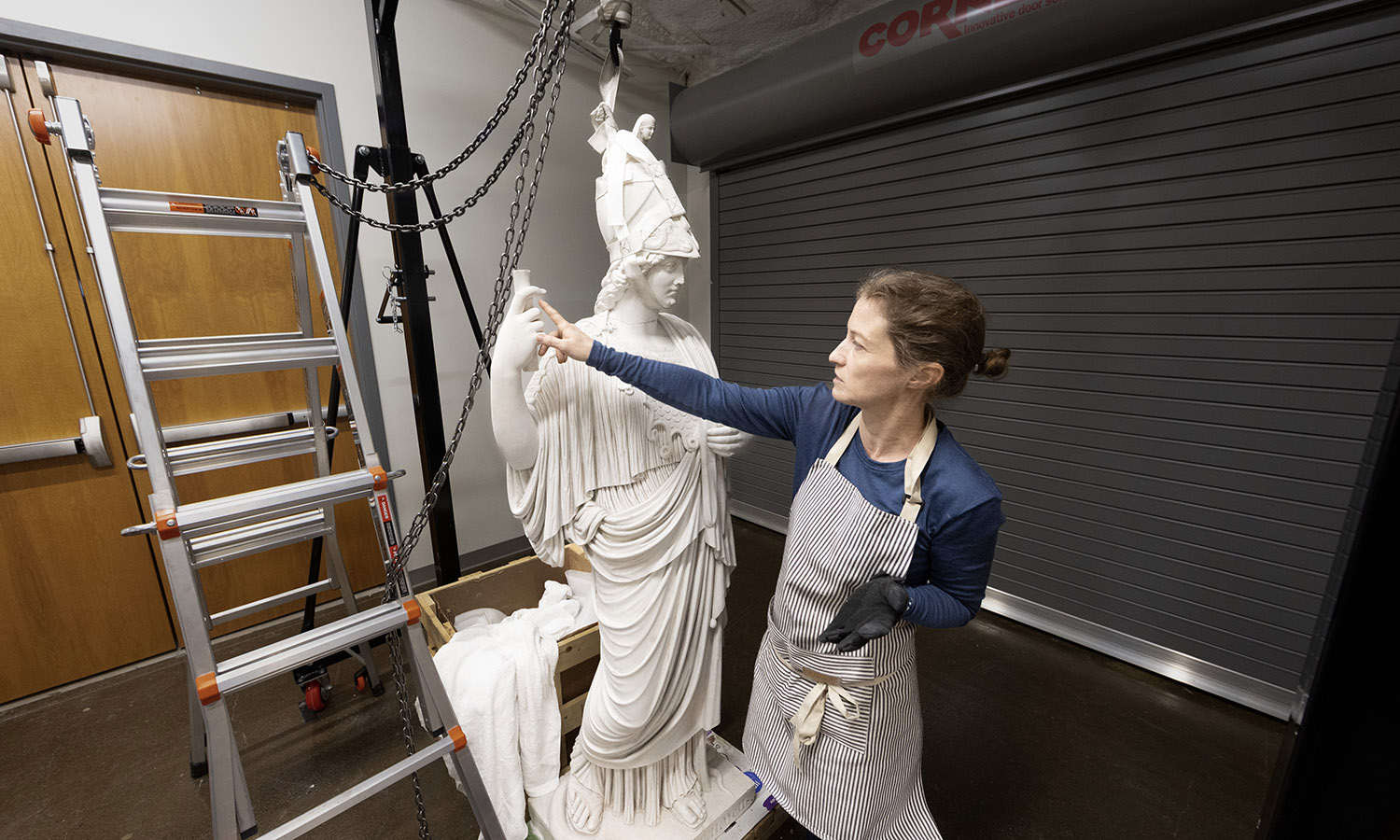
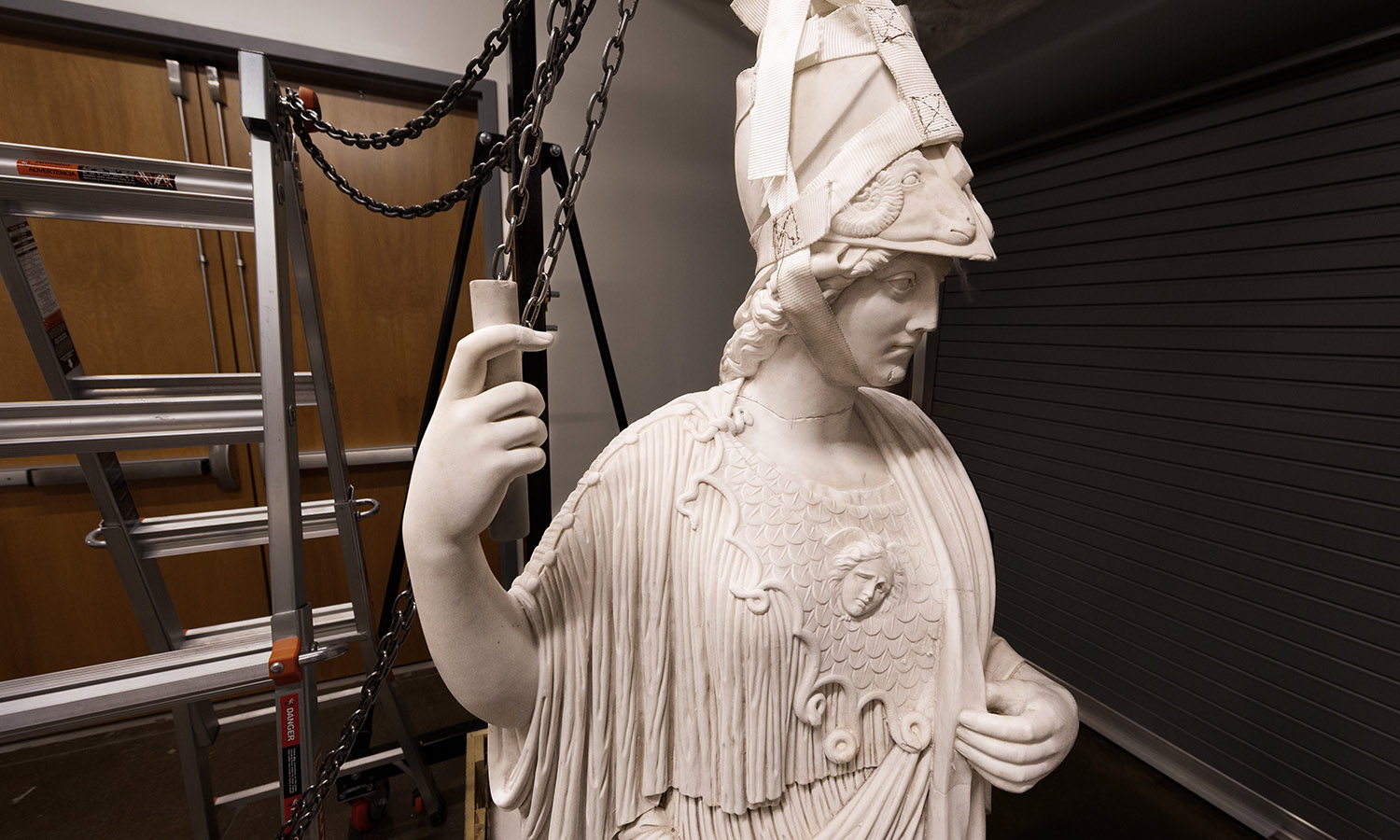
Among the stored fragments provided to Isaacs, she discovered parts of Minerva’s index finger and the object she holds, eventually identified as a scroll symbolizing learning. Old photographs helped Isaacs determine how the pieces originally aligned.
Previous attempts to repair the finger had used improper adhesives. To restore it correctly, Isaacs removed the old glue and inserted a metal pin — in a process similar to orthopedic surgery — before reattaching the marble.
“I basically had to draw a straight line as though it were a bone that went through the finger,” she says.
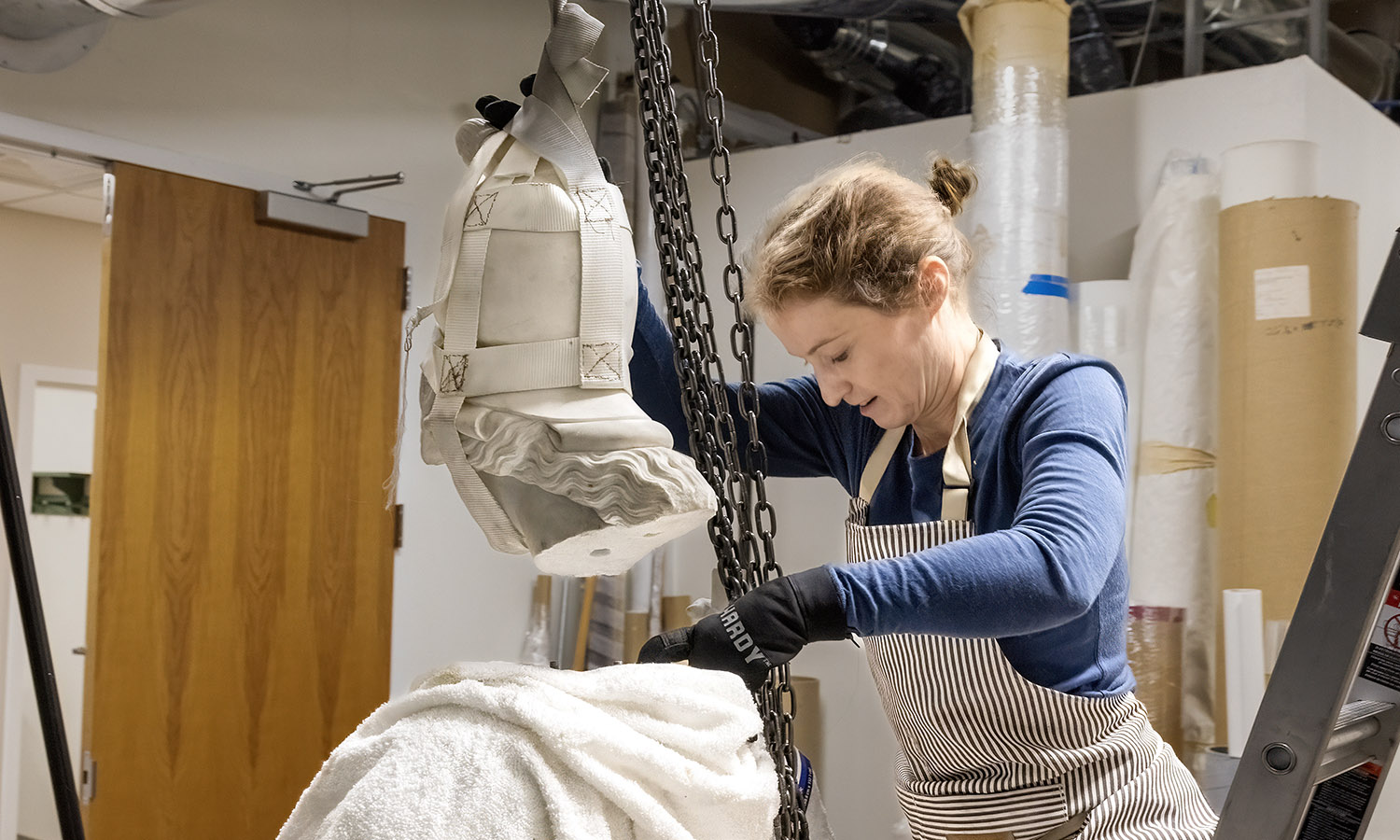
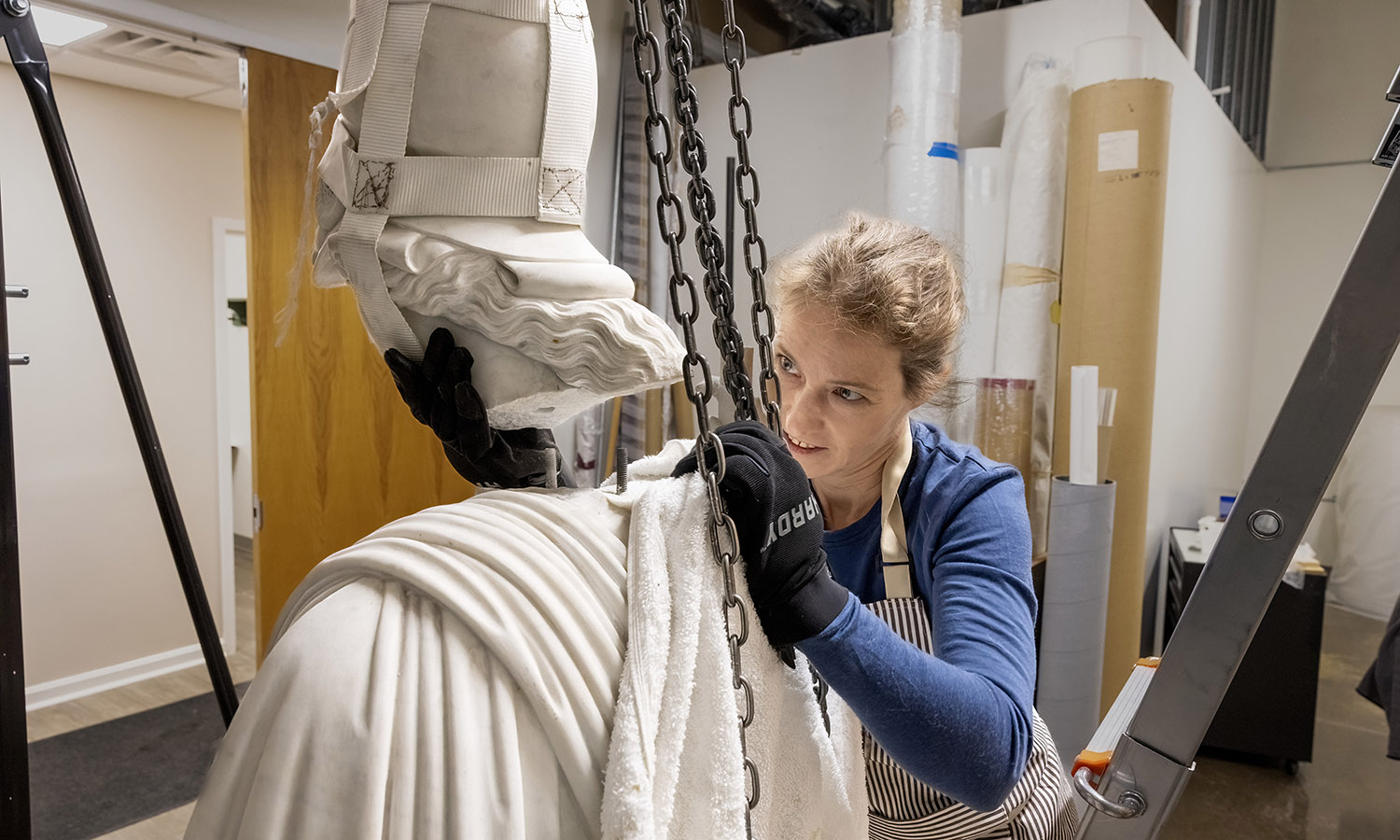
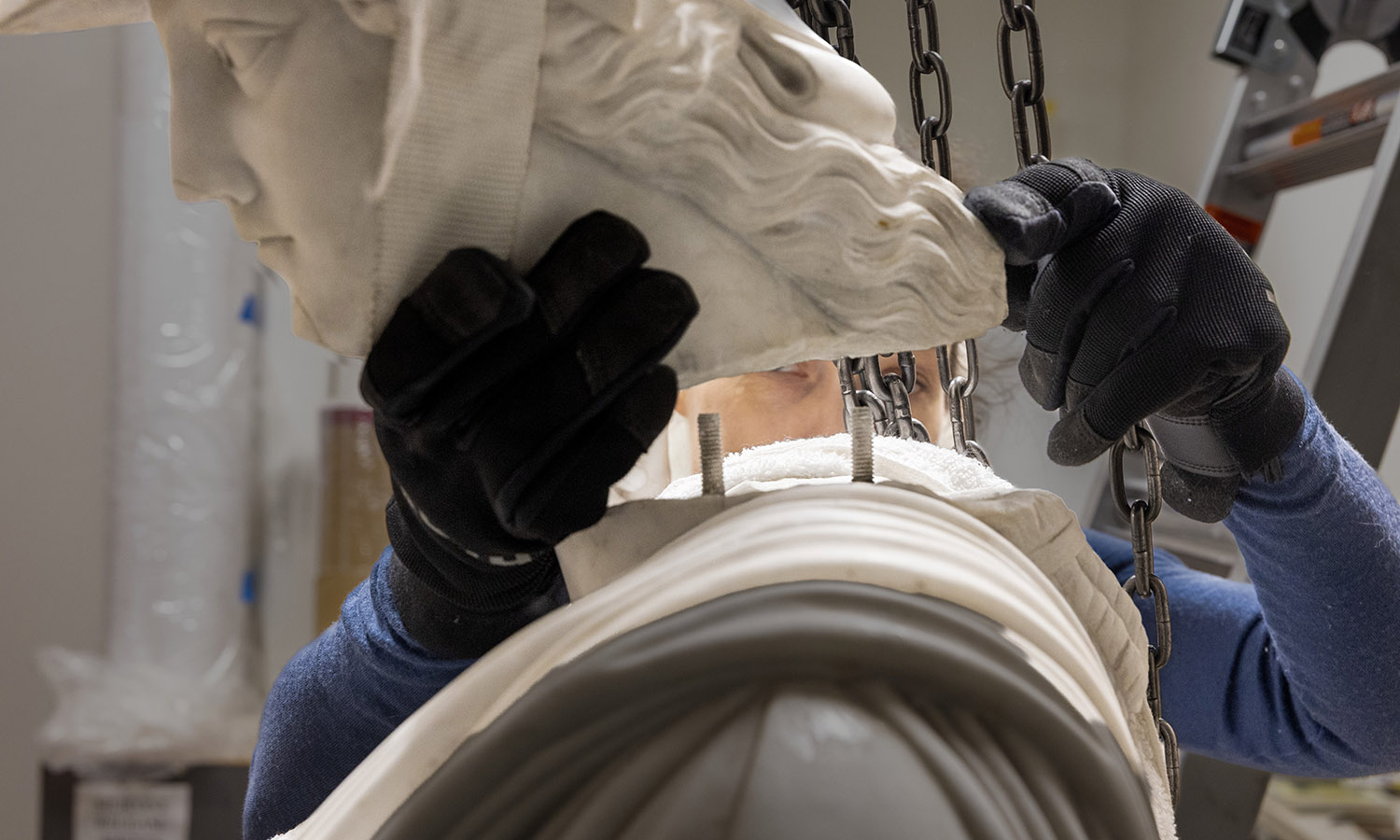
Reattaching the statue’s head, which weighs roughly 60 pounds, required even greater precision. Using a gantry crane to control the piece’s weight distribution, Isaacs carefully drilled two metal pins into the marble and slowly lowered the head into place, millimeter by millimeter.
The smallest shift during installation could have fractured the stone all over again.
Damage Done Out of Care
Despite the heartbreak alumni felt when the statue broke, Isaacs saw something meaningful in its history.
Unlike many sculptures she encounters in her conservation work, Minerva had not been vandalized or deliberately defaced. Instead, most of the breaks occurred during efforts to maintain or protect her.
“It sounded like most of the damage wasn’t anything malicious,” she says. “It was all just kind of loving her and keeping the traditions alive in the school.”
Even the envelopes containing the statue’s broken fragments reflect that care. In her experience, clients very seldom manage to retain those precious remnants, but Wells did.
“To me, that means a lot,” Isaacs says.
Minerva’s Life at Wells
The Roman goddess of wisdom stood in a nook by the front door to the Main Building at Wells after a devastating fire burned down the original building in 1888. Following the fire, responders found Minerva still standing thanks to the sturdy bell tower above her that withstood the flames, unlike the wooden roof that collapsed the rest of the building.
Over more than a century, students from neighboring colleges attempted pranks using Minerva. In 1975, six students from Hobart were caught after stealing the statue. The harm she incurred in the process was repaired, and she was returned to Wells, where she continued to serve as a comforting symbol to students.
On Wells’ Moving Up Day ceremony, held on the last day of spring semester classes, seniors would place a rose at Minerva’s feet and kiss her big toe for good luck.
During Minerva’s conservation, Paige Isaacs spoke to many local residents and former students about the statue’s significance on campus. One remembered regarding the statue as a kind of confidant she spoke to on her walk home at the end of the day. Seeing Minerva lit up at night made her feel safe, Isaacs says. “That was something important to them — having accessibility to this life-sized sculpture that was there waiting for them.”
A Complete Figure Again
After weeks of research and planning, Isaacs stabilized the marble, reattached the head and other fragments and aligned the scroll and finger so the sculpture once again reflects its intended form.
“I don’t really get emotional with my pieces,” she says. “But for this, learning as I went along really was helpful in treating her with the respect I think that she deserves.”
Now restored, Minerva stands ready for her next chapter, which Paige Isaacs says can be indoors or outdoors. (Her permanent location on campus at HWS has yet to be decided.) Paige Isaacs says she just hopes students will have access to her the way they did at Wells, so Minerva can continue to provide inspiration and connection to future generations who encounter her.
Top: Conservator Lauren Paige Isaacs describes her approach to repairing the Minerva statue.