HWS News
12 December 2025 • Faculty Charting a Path Through Global Complexity
In London, Professor Vikash Yadav explored how countries can foster innovation and safeguard freedoms while meeting the challenges of a changing world.
In early December, Professor of International Relations and Asian Studies Vikash Yadav traveled to London to discuss contrasting government approaches to economic development and climate change. At King’s College London, Yadav delivered the plenary address at a public symposium, and at the London School of Economics and Political Science, he presented to scholars in a closed session.

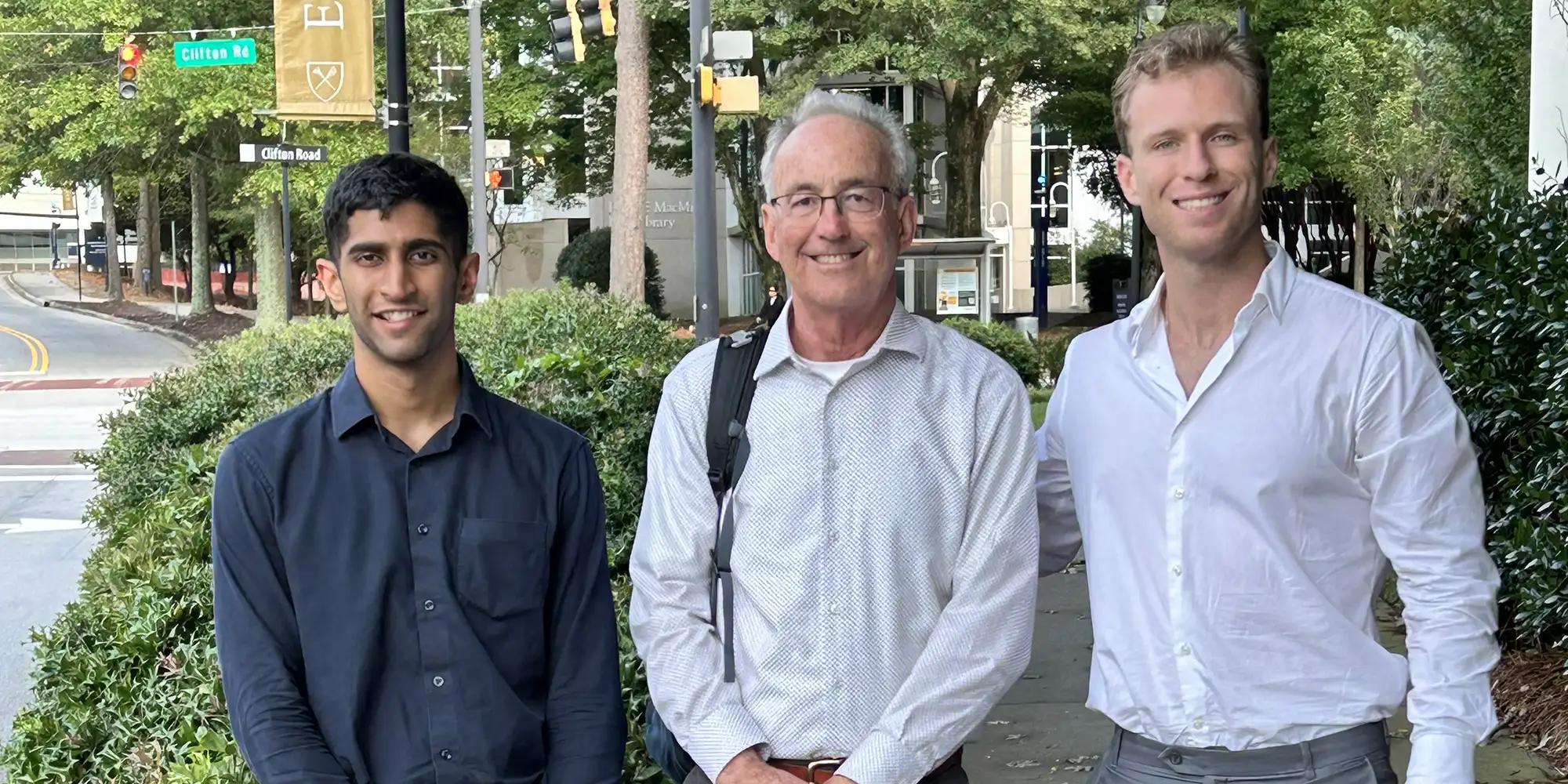
Professor of International Relations and Asian Studies Vikash Yadav (center right) with faculty participants at the London School of Economics and Political Science "Complexity and Liberalism in Development Studies" workshop sponsored by LSE and the Institute for Human Studies.
Yadav was invited to the London School of Economics nearly a year ago, originally to speak about his 2023 book Liberalism’s Last Man: Hayek in the Age of Political Capitalism (University of Chicago Press). In the book, Yadav examines the struggles open societies face in trying to match the economic productivity of authoritarian, state-guided economies.
When scheduling pushed the event into this academic year, the discussion expanded into a larger public symposium, “Complexity and Liberalism in Development Studies,” sponsored by the Institute for Human Studies and LSE. The gathering examined how societies can promote economic development while protecting individual liberties.
“There’s an assumption in development studies that state-led, top-down planning is the surest way to grow an economy,” Yadav said. “But we’re trying to explore approaches that respect decentralization, individual freedom and bottom-up problem solving, while still making meaningful progress.”
Manufacturing decline
At LSE, Yadav presented new research on India’s semiconductor ambitions in a paper titled “Managing Complexity: India’s Semiconductor Ambitions and New Industrial Policy.” Semiconductors, he noted, are “essential to everything from consumer electronics to advanced military equipment,” and India is investing billions in an effort to break into high-end manufacturing.
But Yadav’s analysis suggests caution. India has attempted versions of this strategy before, including in the early 1980s, and the results were disappointing.
“The government is trying to imitate Silicon Valley venture capital with public money,” he said. “But governments tend to be risk-averse. They want quantifiable deliverables every quarter, and that’s not how disruptive technologies emerge.” While India has deep engineering talent, directing it into manufacturing instead of design requires a better approach than incentives and subsidies, which he says have been ineffective in securing cutting edge semiconductor manufacturing.
His skepticism extends to other countries, including the United States. “Tech manufacturing looks like the glamorous path, but it may not align with a country’s true strengths.”
Climate change
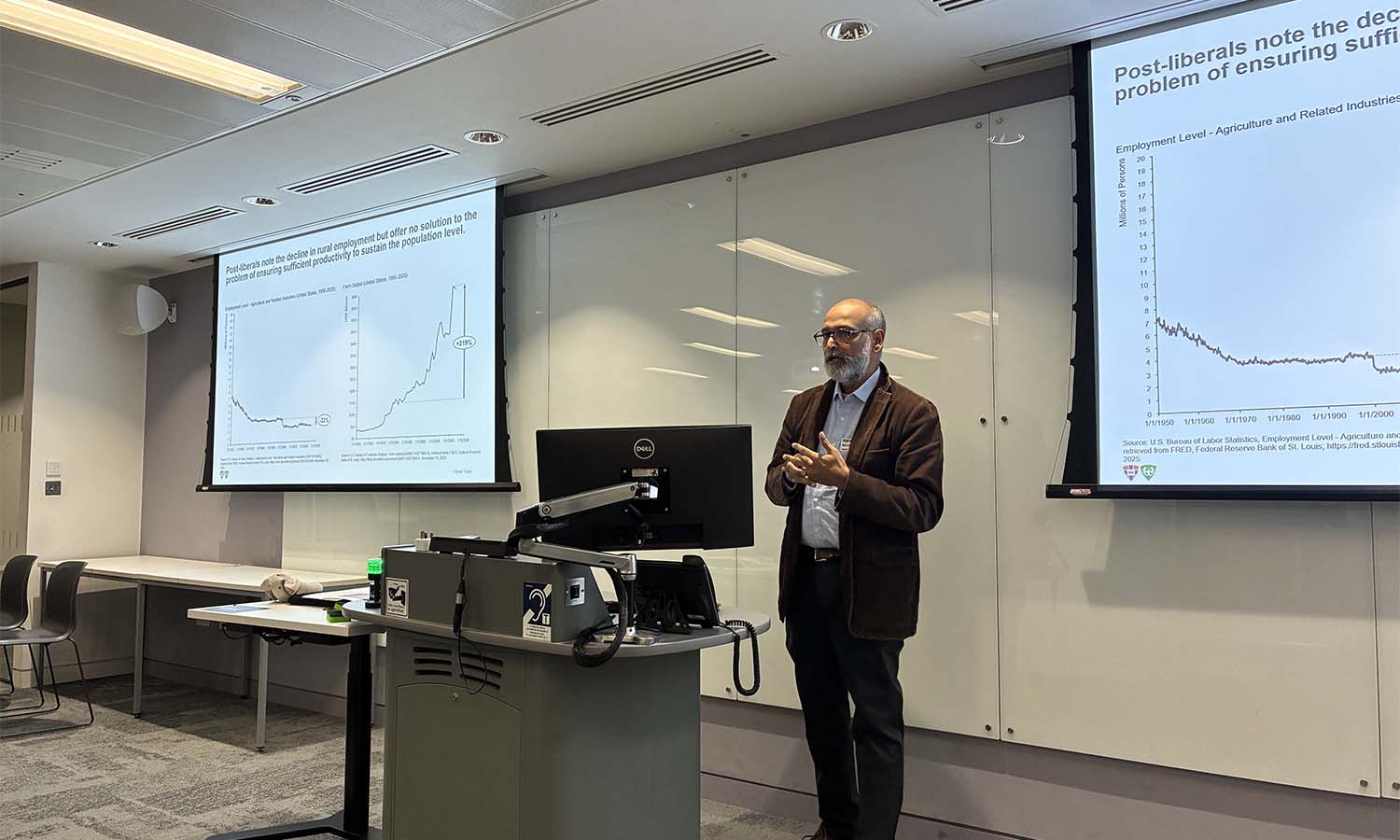
Yadav delivered a separate talk at King’s College London on “Populism, Post-Liberalism and Climate Change,” examining how high-income countries are responding to the dual challenges of manufacturing decline and global warming. In his talk, he compared the American and Chinese approaches to these issues.
In his view, the United States — like many high-income countries — is increasingly turning toward interventions that are not only ineffective, they conflict with long-held economic traditions.
“We're putting up protectionist barriers, we're raising tariffs; we're basically trying to close ourselves off in ways that don't seem to follow American values,” Yadav explains.
Climate change, he says, is another pressing concern, but instead of rising to the challenge, the U.S. pushes it to the side or uses non-market solutions, such as limiting competition or using subsidies. “Meanwhile, the Chinese have seen this as an opportunity to gain a first-mover advantage in green manufacturing. So, in a way, their solution is reinforcing authoritarian political capitalism whereas our solutions are undermining liberalism as an economic and political strategy.”
Yadav says there are alternatives for high-income countries to meet these challenges.
As an example, he pointed to the Dutch model of “flexicurity,” which ensures employees get 90 percent of their wages for two years while attending privately-run retraining centers. “The aim of ‘flexicurity’ has been to shift workers’ mentality from job security to employment security, where instead of saying, ‘I have a right to this job,’ saying, ‘I am employable. I just need to change my skills.’”
The shift allows firms greater flexibility in hiring and firing to promote dynamism and innovation without abandoning social protections — and without relying on top-down state interventions.
For Yadav, the week in London offered a chance to test ideas in conversation with scholars and students confronting similar questions in their own countries. “It was hectic but energizing,” he said. “We’re all working on different pieces of the same problem — how to promote development, democracy and sustainability in a complex world.”
Top: Professor of International Relations and Asian Studies Vikash Yadav lectures at King's College London on the topic of "Populism, Post-Liberalism and Climate Change."