HWS News
17 May 2026 • Outcomes We Achieve Nothing Alone
Dame Louise Richardson urged Hobart and William Smith graduates to embrace lives grounded in community, calling it the “antidote to despair and the foundation of purpose.”
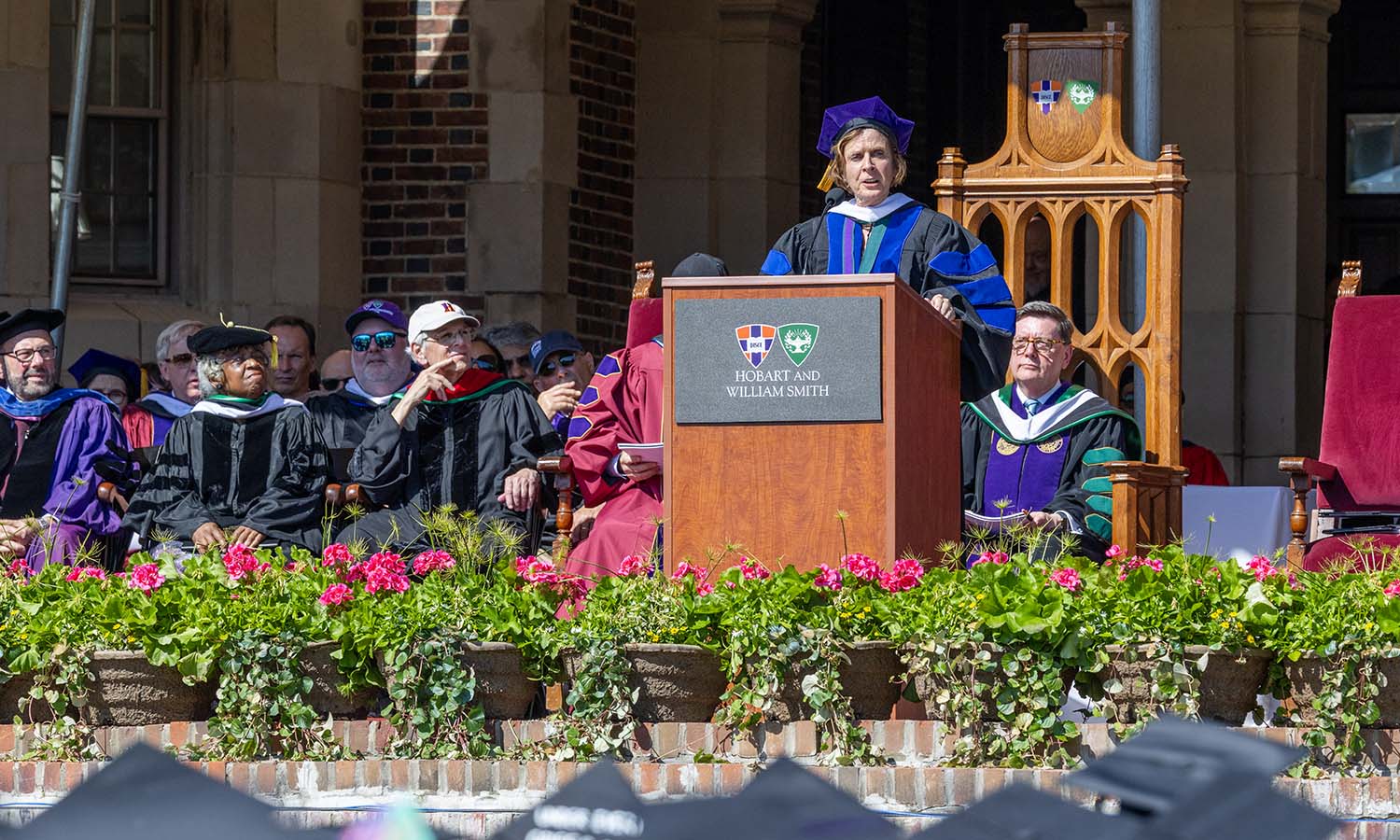
Accepting an Honorary degree and Hobart and William Smith’s Elizabeth Blackwell Award, Richardson challenged graduates to reject isolation and individualism for empathy, cooperation and collective responsibility. Drawing on her experience leading Carnegie Corporation of New York as well as the Universities of Oxford and St. Andrews, Richardson described community building as graduates’ real task.
“We need, more than ever before, a generation of community builders,” Richardson said. “Building community is…both easier and harder than pursuing your goals alone. It is a matter of small steps and meaningful acts.”
Throughout the address, Richardson evoked images of interconnectedness — from murmurations of migratory birds flying together in formation, to coral reefs and underground fungal networks that thrive through cooperation instead of competition.
“I believe that true community is the antidote to despair and the foundation of purpose,” she said. “It is not a dilution of individual character but a concentration of shared energy.”
Richardson also warned graduates about the growing forces of division and polarization shaping public life.
“It will take concentrated effort to overcome the algorithms that keep us in opposing camps, shaking our heads and our fists at those who disagree with us,” she said, “but it has never been more vital to leap the fence.”
Richardson tied those ideas directly to the legacy of Dr. Elizabeth Blackwell, the pioneering physician and HWS alumna for whom the award is named. She reflected on the collective decision by students at Geneva College — HWS’ predecessor institution — to admit Blackwell in 1847, opening a path for women in medicine.
She also praised HWS students’ longstanding commitment to service and civic engagement, noting HWS’ extensive record of community service and Peace Corps participation.
“The students and educators of this college recognize that collaboration, giving and creating opportunities for others is the basis of the good society and the well-lived life,” she said.
Themes of gratitude, connection and shared responsibility echoed throughout the ceremony, including in President Mark D. Gearan’s valedictory remarks to graduates.
Reflecting on how much the world had changed since the Class of 2026 arrived on campus, Gearan noted that ChatGPT had not officially launched prior to the students’ first semester at HWS. While acknowledging both the promise and concern surrounding artificial intelligence, Gearan reminded graduates that technology could never replace character.
“One thing is clear,” Gearan said. “You can still be a better person.”
“Some may say machines will have all the answers,” he continued, “but you can still be a better person.”
Gearan connected that message directly to the lives of the four honorary degree recipients recognized during the ceremony, describing them as examples of lives dedicated to service and community.
“And this platform party and four honorary degree recipients offer examples of lives well led,” Gearan said. “They offer you four examples of individuals who have worked each day to be a better person and advance their community, their parish, their nation and the global philanthropic world.”
In addition to Richardson, the ceremony honored community advocate Lillian Collins, Father Thomas P. Mull and Lt. General John L. Woodward Jr. ’68 with honorary degrees. [Their citations can be found here.]
Gearan praised Collins for her decades of service to HWS and the Geneva community, Mull for nearly 50 years of spiritual leadership in the Finger Lakes region including on campus, and Woodward for his distinguished military career and commitment to national service. He also highlighted Richardson’s path as a first-generation college student who became the first woman to lead Oxford and St. Andrews and the first woman president of Carnegie Corporation of New York.
“All of these individuals are making a difference, giving back and making this world a better, safer, more just and empathic place,” Gearan said.
Echoing Richardson’s central message, Gearan urged graduates to carry forward the examples set by the honorary degree recipients.
“Take these examples and all the examples you have from your faculty, coaches, staff and Geneva neighbors to lead a better life,” Gearan said. “We need you out there. Heed the advice of Dame Richardson that building community is your real task. Go out there and be a better person.”
Senior speeches were delivered by Randy Hong ’26 and Maeghan Mahoney ’26.
Hong, a Posse Scholar from Winnetka, Calif., who double majored in computational neuroscience and public health, reflected on the sacrifices made by his father, who sat in the audience Sunday morning, after rebuilding his life in the United States as a Vietnamese refugee.
“This accomplishment — graduating college — is one that I share with him,” Hong said. This fall, Hong will pursue his Ph.D. in neuroscience at the University of California, Davis.
Calling on classmates to reflect on the people who supported them along the way, Hong urged graduates to “find greatness for the sake of the people who want you to succeed the most.”
Mahoney, a biology and environmental studies double major from Phelps, N.Y., encouraged graduates to meet a changing world with courage, compassion and curiosity.
“HWS did not give us answers,” Mahoney said. “It gave us something better — the ability to ask the right questions, and the courage to pursue them.”
Quoting Bob Dylan’s “The Times They Are A-Changin,’” Mahoney encouraged classmates to “start swimming” toward meaningful change and to use their education in service of others.
“Let your knowledge be a bridge, your relationships be a foundation, and your compassion — the kind the world needs so much of right now — be the thing that holds it all together,” she said.
This fall, Mahoney will pursue a master’s in public health at SUNY Upstate Medical University.